Solar Max has arrived, but only half of the sun has been fully participating. Most of the action in the past year, including the geomagnetic superstorm of May 2024, resulted from activity in the sun's southern hemisphere. Today we discuss whether a second peak might be coming as the sun's northern hemisphere catches up. Full story @ Spaceweather.com (archive)
Solar and geomagnetic indeces for high-latitude ham radio operators and DX listeners (since 2010)
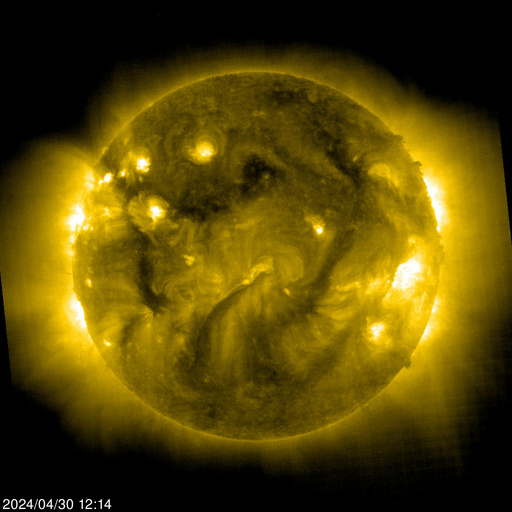
Sun Now! (SOHO) - Click images for more data

Solar X-ray & Proton Flux, Geomagn. act. (NOAA SWPC) - Click the image for more data

Kyoto Dst (WDC) - Click the image for hourly data

Realtime solar wind, X-ray and proton flux by DSCOVR@L1 (SWS Australia)


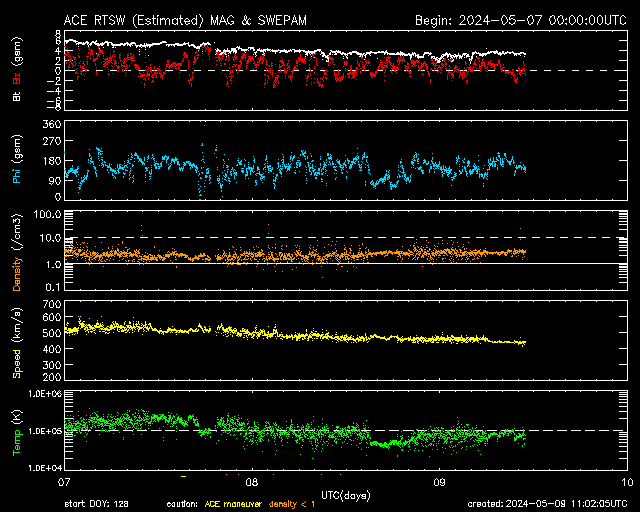
3-day ACE Solar Wind Data (NOAA)
Geomagnetic Activity, K local for Leirvogur (ICE) and Tromssa (NOR)
 |
 |
WSA-ENLIL Solar Wind Prediction (NOAA)
3-day K forecasts
Geomagnetic Activity, Canadian Regions (to be fixed)
Forecast of Geomagnetic Activity, North America (to be fixed)
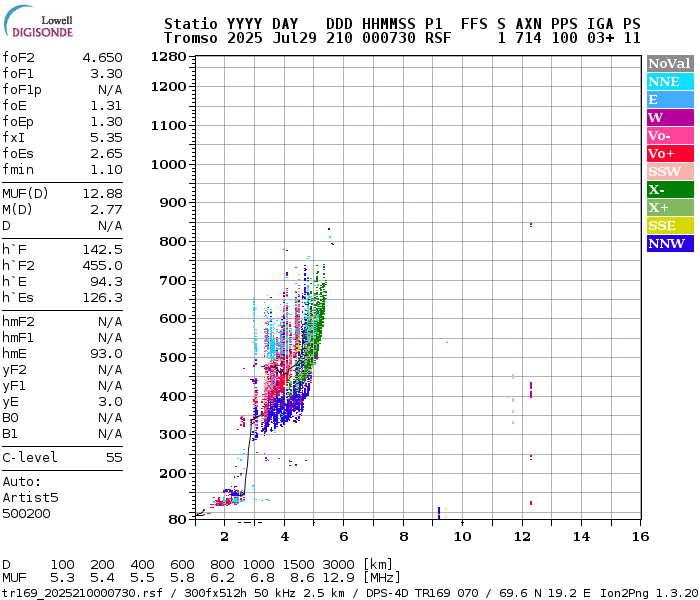
Ionograms for local reference, Tromssa (Norway,TGO) and Sodankylä (Finland, SGO)

2025/02/23
2024/10/19
NASA, NOAA: Sun Reaches Maximum Phase in 11-Year Solar Cycle
In a teleconference with reporters on Tuesday Oct 15,2024, representatives from NASA, the National Oceanic and Atmospheric Administration (NOAA), and the international Solar Cycle Prediction Panel announced that the Sun has reached its solar maximum period, which could continue for the next year.
2024/09/01
Marshall Solar Cycle Forecast - a NASA source
The Space Environments Team in the Natural Environments Branch of the Engineering Directorate at Marshall Space Flight Center (MSFC) provides solar cycle predictions for NASA engineering programs and the aerospace community. Updated monthly.
2024/01/21
Solar Cycle Progression Updated Prediction (Experimental)
Space Weather Prediciton Testbed for Experimental Solar Cycle 25 Prediction
Disclaimer: Products contained on this site are experimental and should not be relied on for operations.
2023/04/18
SOLAR MAX MIGHT ARRIVE EARLY
Spaceweather.com suggests early solar max based on a recent research. Read more.
2022/04/13
Cycle 25 has a higher growth rate than anticipated
Actual data measured recently is indicating that the expected sunspot maximum in July 2025 may not be that weak as earlier expected. This meaning that more intense solar activity and some major geomagnetic turbulence waves expected for next years.
See the report from Spaceweather.com archive
2020/12/09
New solar disk view added
The top of page has now two disk pictures available. On left is the view as nearly seen on visible spectrum light, this is good setting for the sunspot detection. On right is now a new view taken at 284 Ångström wavelenght at 1 million degrees temperature which then provides us a view for possible coronal holes and similar phenomenoms in solar corona.
2020/11/06
Alternative Dst index site
Hence the Kyoto Dst site operated by WDC occasionally seems to be down, I have added below on the link list (Alerts, Forecasts and Reports) a new site for the Laboratory of Atmospheric and Space Physics operated by the University of Colorado. Tnx for the tip by JKZ and SDXL-AM Whatsapp group.
Dst index by LASP, University of Colorado2020/09/16
2019/09/05
2019/07/04
2018/11/05
CORONAL HOLE EVOLUTION PAST SEVERAL ROTATIONS
The MF propagation during past weeks have been very good e.g. from NA towards Nordics. Thanks to some persistent coronal holes there is now an interim reboot on conditions which gives us a break for next good reception round. See more at
https://www.swpc.noaa.gov/news/coronal-hole-evolution-past-several-rotations
https://www.swpc.noaa.gov/news/coronal-hole-evolution-past-several-rotations
2017/09/18
Content refresh having latency
It seems that the graphics on this page are not updated in real time but several hours late. The reason is yet unknown and it is not depending on the browser type or cache operation. Being examined - Now fixed.
2016/09/29
DSCOVR space weather data now available!
Real-time data from DSCOVR and space weather forecasts are now available through the Space Weather Prediction Center. Read more.
2015/02/08
2014/10/21
NOAA´s Space Weather Prediction Center has a new website
Now more solar and geomagnetic data better organised with improved graphics, too. Please check http://origin-www.swpc.noaa.gov/.
2014/07/01
2013/08/06
2013/06/10
2012/12/29
Subscribe to:
Posts (Atom)